
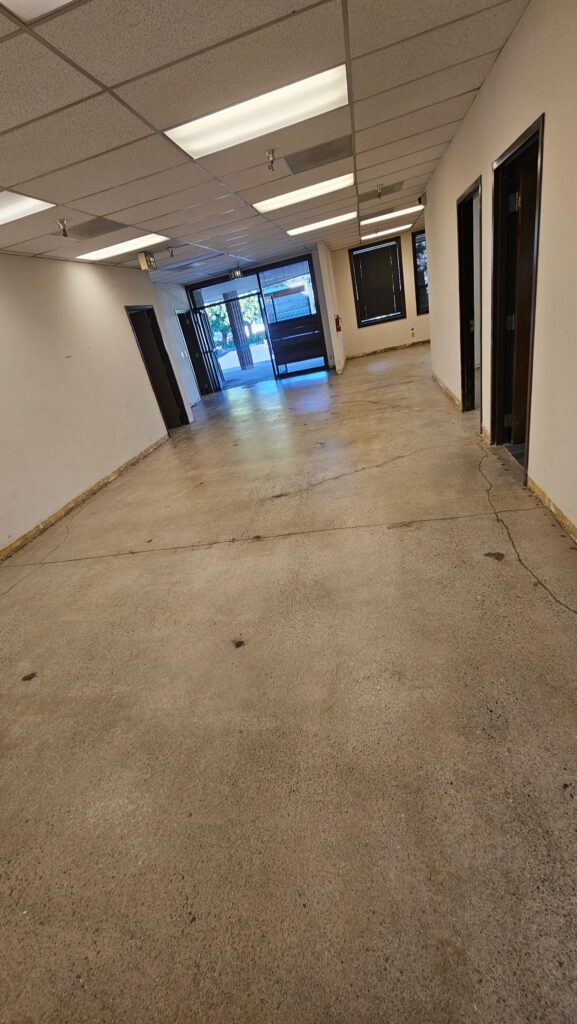
Warehouses, distribution centers, and manufacturing floors put more stress on a slab than almost any other commercial environment. Forklift traffic, pallet drops, chemical spills, and temperature swings all work against the floor at the same time. When facility teams start evaluating options, the conversation usually narrows to two: polished concrete or an epoxy coating. Both are proven choices for industrial spaces, but they solve the problem in fundamentally different ways, and the right answer depends on how the building is actually used.
Two Different Approaches to the Same Slab
Polished concrete is a mechanical process. The existing slab is ground with progressively finer diamond abrasives, then densified and sealed. There is no separate wear layer sitting on top — the finished floor is the concrete. That means there is nothing to delaminate, peel, or chip away from the substrate over time.
Epoxy is a coating system. A resin is applied over a prepared slab and cures into a hard, continuous film. Because it is a topping rather than the slab itself, epoxy can deliver things concrete cannot: a specific color, a seamless chemical-resistant surface, custom slip-resistant texture, and safety striping built into the floor rather than painted on.
Durability and Traffic
Both systems handle heavy loads well when they are installed over a sound slab. The difference shows up in how they fail. Polished concrete wears gradually; heavy traffic lanes may lose some sheen over the years, but the floor keeps functioning and can usually be re-polished. Epoxy tends to fail more visibly — a gouge, a delaminated patch, or a chipped edge in a high-impact zone is obvious, though it can typically be patched or recoated.
For a straightforward distribution or storage environment with forklift and pallet-jack traffic, polished concrete is often a strong fit. For spaces where the floor takes chemical exposure or repeated point impact, a properly specified epoxy system frequently makes more sense.
Chemical Exposure and Cleanability
This is where epoxy usually pulls ahead. A cured epoxy surface is highly resistant to oils, solvents, and many industrial chemicals, and its seamless film gives spills nowhere to soak in. Manufacturing areas, battery-charging stations, wash bays, and food-processing spaces are common candidates.
Polished concrete, once densified and sealed, is far less porous than a bare slab and cleans up easily with routine dust mopping and auto-scrubbing. It is a low-maintenance surface for most warehouse conditions, but aggressive or frequent chemical exposure is generally better served by a coating.
Downtime, Lighting, and Long-Term Cost
Schedule matters as much as performance in an operating facility. Polished concrete is a dry mechanical process with no cure window, so sections can often be returned to service relatively quickly. Epoxy requires surface preparation, application, and cure time before traffic returns — a real consideration in a building that cannot shut down for long.
Two other factors worth weighing:
- Lighting. A polished slab reflects overhead light well, which many facilities find brightens aisles without adding fixtures.
- Life cycle. Polished concrete typically needs periodic re-polishing rather than replacement. Epoxy will eventually need recoating, and the interval depends heavily on traffic and chemical load.
- Slab condition. If the existing slab is badly cracked, patched, or was poured with an inconsistent finish, that history shows through a polish. A coating can hide more of it.
When Neither Is the Right Answer
Some industrial spaces have requirements that go beyond wear and chemical resistance. Electronics assembly, clean rooms, server rooms, and any area handling sensitive components often need static control, which is a different specification entirely. ESD flooring is engineered to dissipate static charge in a controlled way, and it should be evaluated on its own terms rather than treated as an upgrade to concrete or epoxy.
Making the Call
In practice, the decision usually comes down to three questions: What is the slab in, what hits the floor, and how much downtime can the operation absorb? A sound slab in a clean storage environment with tight scheduling points toward polished concrete. Chemical exposure, color or striping requirements, or a slab with a rough history point toward a coating. Many larger buildings end up with both — polished concrete through the racking and aisles, epoxy in the wash bay and maintenance areas.
Before committing either way, it is worth having someone assess the existing slab. Moisture, hardness, and prior treatments all affect what a floor can realistically become, and that assessment shapes the recommendation more than any general comparison can. You can see how these systems fit into a broader facility plan on our industrial and warehouse flooring page.
RC Floors works with Bay Area warehouses, distribution centers, and manufacturing facilities to specify and install flooring that matches how the space actually runs. Request a quote or call us at (925) 269-4024 to talk through your slab and your schedule.